
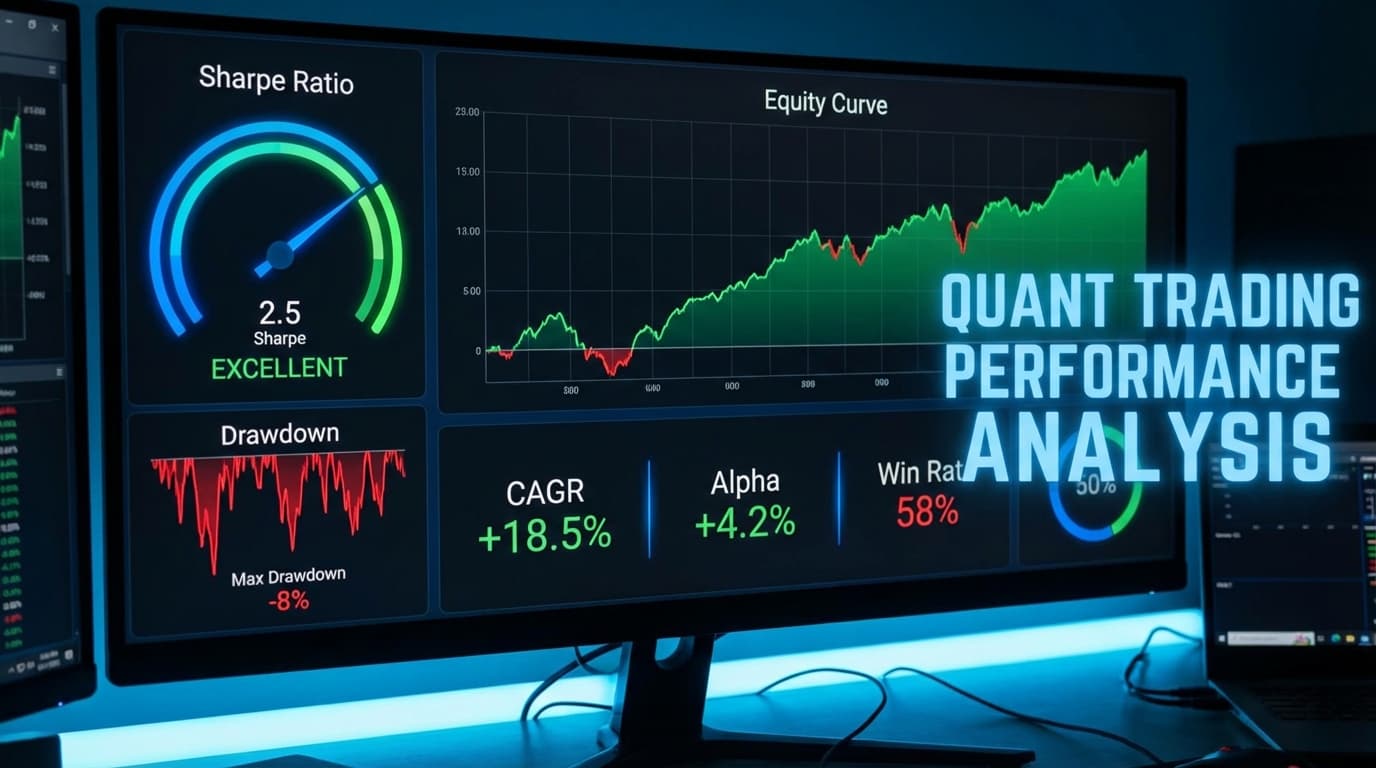
Why Strategy Metrics Matter
Backtesting a strategy that shows profit isn't enough. You need to understand how it made that profit and what risks it took along the way.
A strategy making $10,000 with a 50% drawdown is very different from one making $10,000 with a 10% drawdown—even though the P&L is identical.
Key Metrics in TradingView Strategy Tester
When you run a strategy in TradingView, the Strategy Tester shows multiple metrics. Here's what each means and why it matters.
Net Profit
What it is: Total profit minus total losses over the backtest period.
What's good: Positive number, obviously. But context matters—$10,000 profit on a $100,000 account (10%) is different from $10,000 on $10,000 (100%).
Watch out for: Profit that came from a few lucky trades. Check trade distribution.
Percent Profitable (Win Rate)
What it is: Percentage of trades that were profitable.
What's good: Depends on your risk-reward ratio.
| Win Rate | Required R:R to Break Even |
|---|---|
| 30% | 2.3:1 |
| 40% | 1.5:1 |
| 50% | 1:1 |
| 60% | 0.67:1 |
| 70% | 0.43:1 |
Watch out for: High win rate with poor risk-reward. You can win 80% of trades and still lose money.
Profit Factor
What it is: Gross profit divided by gross loss.
Formula: Profit Factor = Gross Winning Trades / Gross Losing Trades
What's good:
- < 1.0: Losing strategy
- 1.0-1.5: Marginal (may not survive transaction costs)
- 1.5-2.0: Good
- 2.0+: Excellent
Watch out for: Very high profit factors (5+) often indicate curve-fitting or insufficient trade count.
Max Drawdown
What it is: The largest peak-to-trough decline in account equity during the backtest.
Why it matters: Shows the worst-case pain you'd experience. A $10,000 account with 30% max drawdown means you'd have seen your account drop to $7,000 at some point.
What's acceptable:
- Conservative: < 10%
- Moderate: 10-20%
- Aggressive: 20-30%
- Dangerous: > 30%
Formula: Max Drawdown = (Peak Value - Trough Value) / Peak Value × 100
Watch out for: Drawdown duration. A 20% drawdown that recovers in a week is different from one lasting 6 months.
Understanding Sharpe Ratio
What Is Sharpe Ratio?
The Sharpe ratio measures risk-adjusted returns—how much excess return you get per unit of volatility.
Formula:
Sharpe Ratio = (Strategy Return - Risk-Free Rate) / Standard Deviation of Returns
Interpreting Sharpe Ratio
| Sharpe Ratio | Interpretation |
|---|---|
| < 0 | Losing money (worse than risk-free) |
| 0-1 | Suboptimal risk-adjusted returns |
| 1-2 | Good, acceptable for retail |
| 2-3 | Very good, institutional quality |
| 3+ | Excellent (or possibly suspicious) |
Sharpe Ratio Benchmarks
- Hedge funds typically target: Sharpe > 2.0
- Retail traders should aim for: Sharpe > 1.0 (after costs)
- Ignore strategies below: Sharpe < 0.75 (won't survive real trading)
Limitations of Sharpe Ratio
- Assumes normal distribution: Markets have fat tails; extreme events happen more than Sharpe suggests
- Backward-looking: Past volatility may not predict future
- Doesn't distinguish up vs down volatility: Treats gains and losses equally
- Time-period sensitive: Can vary dramatically based on sample period
Beyond Sharpe: Other Risk Metrics
Sortino Ratio
Like Sharpe, but only considers downside volatility.
Better because: You don't mind upside volatility (big gains).
Formula:
Sortino = (Return - Target) / Downside Deviation
Calmar Ratio
Annualized return divided by maximum drawdown.
What it tells you: How much return you get per unit of max pain.
Formula:
Calmar = Annualized Return / Max Drawdown
Good Calmar: > 1.0 (annual return exceeds worst drawdown)
CAGR to Max Drawdown
Some argue this is better than Sharpe for trading strategies:
Formula:
CAGR/MaxDD = Compound Annual Growth Rate / Maximum Drawdown
Why it's useful: Focuses on what traders actually care about—long-term growth vs worst case.
RoboQuant Strategy Lab Metrics
RoboQuant's Strategy Lab provides additional analysis:
Equity Curve Analysis
- Smoothness of returns
- Drawdown periods highlighted
- Recovery time visualization
Trade Distribution
- Win/loss distribution
- Outlier identification
- Streak analysis
Risk Metrics Dashboard
- Sharpe ratio
- Sortino ratio
- Max drawdown
- Calmar ratio
- Recovery factor
Monte Carlo Simulation
- Probability of various outcomes
- Confidence intervals
- Worst-case scenarios
How to Analyze Your Strategy
Step 1: Check Minimum Trade Count
You need enough trades for statistical significance:
- Minimum: 30 trades
- Better: 100+ trades
- Ideal: 500+ trades
With fewer trades, any metric is unreliable.
Step 2: Evaluate Core Metrics
| Metric | Minimum Acceptable | Target |
|---|---|---|
| Profit Factor | > 1.2 | > 1.5 |
| Sharpe Ratio | > 0.75 | > 1.5 |
| Max Drawdown | < 30% | < 15% |
| Win Rate | > 35% | > 50% |
Step 3: Check for Red Flags
Warning signs of curve-fitting:
- Very high Sharpe (> 4) or profit factor (> 5)
- Few trades generating most profit
- Metrics much better in backtest than forward test
- Parameters very specific (41-period MA, not 40 or 42)
Step 4: Stress Test
Modify conditions to test robustness:
- Different time periods
- Different symbols
- Slight parameter changes
- Added transaction costs
If performance collapses, strategy may be overfit.
Step 5: Compare to Benchmark
Your strategy should beat:
- Buy and hold of the same asset
- A simple moving average crossover
- Risk-free rate (at minimum)
Practical Example
Strategy Analysis
Strategy: RSI + EMA crossover on ES futures
Backtest Results:
- Net Profit: $45,000
- Total Trades: 250
- Win Rate: 48%
- Profit Factor: 1.65
- Sharpe Ratio: 1.42
- Max Drawdown: 12%
- Average Trade: $180
Analysis:
✅ Good signs:
- Profit factor 1.65 is solid
- Sharpe 1.42 indicates good risk-adjusted returns
- 12% max drawdown is manageable
- 250 trades provides statistical significance
⚠️ Things to verify:
- Is the 48% win rate consistent or were there lucky streaks?
- How long was the max drawdown period?
- Does it work on other symbols?
Verdict: Worth forward testing with small size.
Improving Your Metrics
To Improve Sharpe Ratio
- Reduce trade volatility (consistent position sizing)
- Cut losing trades faster
- Avoid overtrading
- Filter low-quality setups
To Reduce Max Drawdown
- Smaller position sizes
- Tighter stop losses
- Diversify across uncorrelated strategies
- Add trend filters (don't trade against major trends)
To Improve Profit Factor
- Let winners run longer
- Cut losers sooner
- Better entry timing
- Avoid revenge trading
Conclusion
Metrics like Sharpe ratio and maximum drawdown separate gambling from systematic trading. Before risking real money:
- Ensure adequate trade count (100+ minimum)
- Target Sharpe > 1.0 and max drawdown < 20%
- Verify consistency across time periods
- Forward test before going live
Numbers don't lie—but they can deceive if you don't understand what they mean.
Ready to analyze your strategies properly? Try RoboQuant's Strategy Lab for comprehensive metrics and Monte Carlo analysis.